
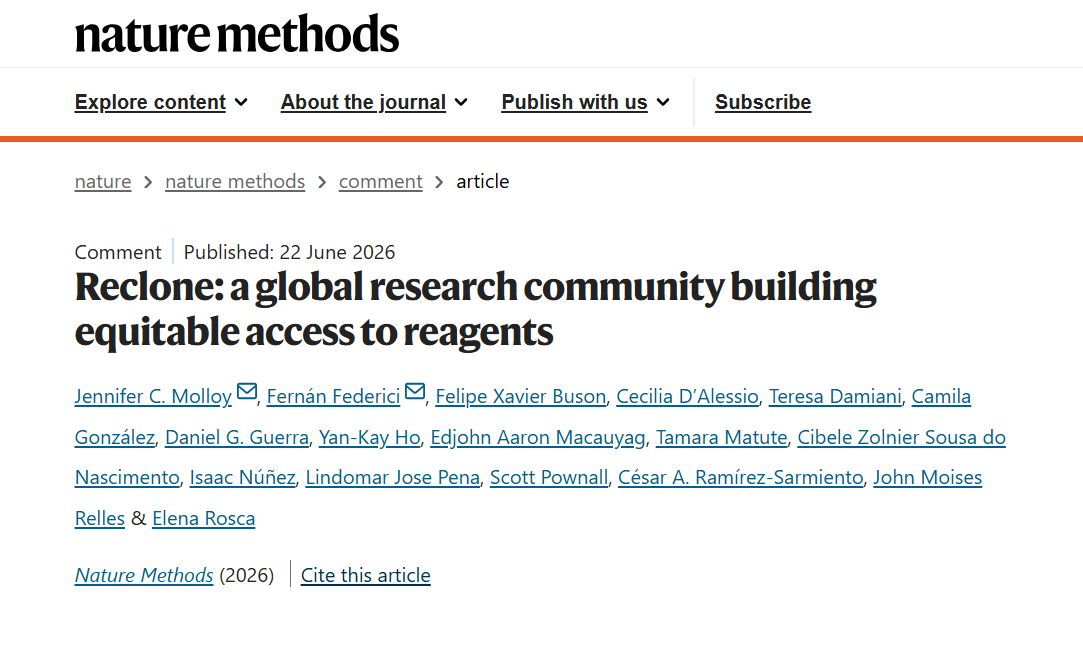
We are excited to announce the publication of “Reclone: a global research community building equitable access to reagents” in Nature Methods, marking a significant milestone for our initiative and the broader open biotechnology movement.
The paper, co-authored by Reclone Global Co-Leads Dr. Jenny Molloy (University of Cambridge | ICGEB) and Dr. Fernán Federici (Pontificia Universidad Católica de Chile), and collaborators from several institutions, documents Reclone’s model for democratizing access to essential biological tools and reagents, and the evidence behind it.
Biological reagent production remains concentrated in a small number of countries, leading to high costs, long wait times, and logistical barriers for researchers in low- and middle-income countries (LMICs). In the paper, the authors describe how Reclone’s open, collaborative model — built on the exchange of DNA, protocols, knowledge, and local production capacity — directly addresses these barriers.
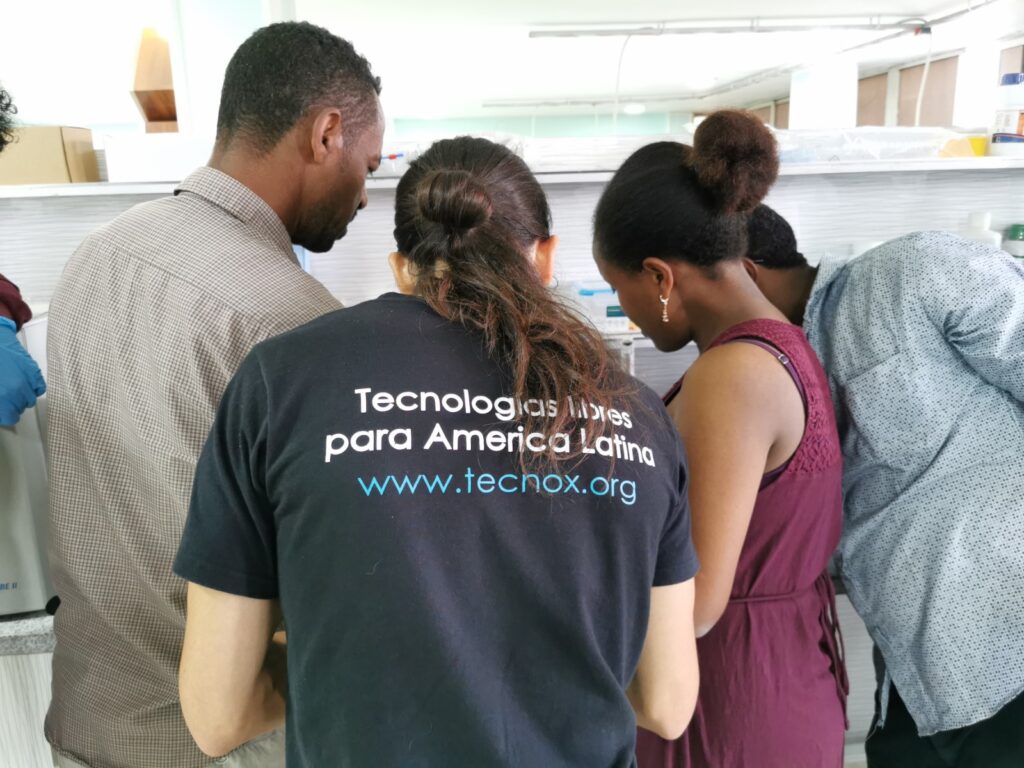
Since its founding in 2020, Reclone has grown to connect universities, research institutes, companies, and scientific communities across more than 40 countries. Key outcomes presented in the paper include an open collection of more than 580 DNA parts for research and protein production, regional distribution hubs across Latin America, Africa, and Asia, and the training of hundreds of students, educators, and researchers in molecular biology and biomanufacturing.
In 2024, Reclone secured a grant from the Chan Zuckerberg Initiative (CZI) to further support the work in Latin America, with a Hub at Universidad Nacional de Cuyo (UNCUYO) and new nodes in Chile and Peru. Part of these efforts included launching an open call for Starter Kits, which are now being distributed to 135 participants across 13 Latin American countries.
The publication also showcases the community’s development of Open Educational Resources (OER) and freely accessible protocols that combine open-source hardware and open reagents to support hands-on training in molecular biology. These resources enable researchers to perform fundamental molecular diagnostic techniques, including PCR, LAMP, and RNA-based sensing, helping expand access to practical biotechnology education in resource-limited settings.
This publication in Nature Methods is a recognition that community-driven, open science models are a legitimate and impactful approach to addressing systemic inequities in global research infrastructure. Reclone continues to expand its network and develop new open technologies to strengthen the scientific and technological sovereignty of countries in the Global South.
“I’m especially excited to harness recent open source tools for protein engineering and automation to collaborate on open “workhorse” reagents that are best in class and hyperstable for cold-chain free transport. True equity moves beyond increasing access to existing technology. We need to co-develop new tools with scientists in low- and middle-income countries, that truly meet their day-to-day research needs”, said Dr. Jenny Molloy, Reclone Global Co-Lead.
The article is available at: www.nature.com/articles/s41592-026-03148-0
We thank all co-authors for supporting this initiative: Jennifer C. Molloy, Fernán Federici, Camila González, Cecilia D’Alessio, César A. Ramírez-Sarmiento, Cibele Zolnier Sousa do Nascimento, Daniel G. Guerra, Edjohn Aaron Macauyag, Elena Rosca, Felipe Xavier Buson, Isaac Núñez, John Moises Relles, Lindomar Jose Pena, Scott Pownall, Tamara Matute, Teresa Damiani, Yan-Kay Ho.
We also thank our partners and institutional collaborators: University of Cambridge, ICGEB, UC Chile, iBio Chile, UNCUYO, Ashesi, Ateneo, UPD, UPCH, Fiocruz, Uniandes, UBA, USP, OSNS, and BETin. As well as our grant supporters: CZI and CYTED.
Stay connected with us as this movement grows! Follow us on Instagram and LinkedIn for the latest updates and opportunities to get involved.
For more information, reach out at: coordination@reclone.org
 EN
EN  ES
ES